Do you know the new ATC equipment code suffix for your airplane?

John Mahany • July 5, 2023

Share this article

I bet maybe you don’t. I thought I did, until recently. Did you know that the ATC equipment code suffixes have changed? Yup, they have! In fact, they changed about 4 years ago, in 2019! I’m talking about the suffixes, like /T or /U or /G  ‘codes’ that we used to use for our avionics capability when talking to ATC or when filing a flight plan, as in, a Cessna 150/U? Well, it has changed.
So how did I learn this? Well, I have been aware of it, but I have not been using the new codes, not when flying my Cessna 150. No ATC controllers at SoCal have said anything to me. Nor any of the briefers at LEIDOS, when I have called many times for a weather briefing.

However, recently when I called Leidos, 1-800-wxbrief, for a standard weather briefing, when I initially told the briefer that my Cessna 150 was a ‘/U’, boy he called me out for this and went on a RANT! He spent several minutes reprimanding, like I shoulda known better, oops, and spelling it out in some detail, and all I could say was, sorry, I goofed. No point in arguing. Mea culpa. Yep. But gee, last summer, when flying my Cessna 150 2/3’s of the way across the country to Oshkosh for AirVenture, not one briefer made any mention of this. Hmm. Well, that’s just the way it is.

So, what’s behind this? Well, as I see it, this is due to the introduction of so many new avionics units/devices on the market in recent years; by several manufacturers, and because of so many different GPS receivers now.  And, also because of the many newer displays (glass cockpits) and transponders now, and the varying capabilities of each, the FAA has had to ‘recategorize’ avionics, according to what each does. That’s how I see it. E gads! Hard to keep up.

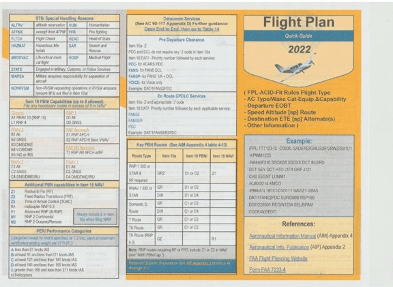
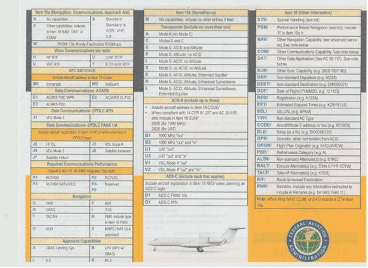
So, do you know the codes for the airplane you fly? It depends on what avionics you have. Have you seen the FAA form that sort of ‘explains’ this? In the AIM, the ‘flight planning form’ is in the back, in Appendix 4. At the beginning of the Appendix are several pages of explanations. Officially, it’s FAA Form 7233-4-International Flight Plan.

I find it to be confusing! Maybe because I’ve been using the old flight planning form for so long. So, I’ll try and explain a little of it. Very briefly. With thanks to Richie Lengel, and his very popular book ‘Everything Explained for the Professional Pilot’….; instead of the suffix U which was for Transponder with Mode C Altitude Reporting and no DME, if you are flying a single engine airplane, with ‘standard avionics’ including NavCom with VOR/ILS and VHF communications, like many of us, then your equipment code/suffix is now ‘S’. And for the transponder code, now there are three choices; A, C or S. For my 150, it’s now code C. There’s MUCH more to this. But I can see I’m going to have to work on creating a pamphlet to explain this, in more detail, and better.

That’s all for now. I have my work cut out for me.

In the meantime, fly safely!

John

Recent Posts

By John Mahany July 3, 2026
My topic; SOPS for IFR and VFR Pilots. Do you use SOPS when you fly? Learn how using SOPS can make you a better, safer pilot.
By John Mahany June 26, 2026
It’s been a busy month for me, so I’m late with this. I recently had a chance to fly a Bushcat LSA, or Light Sport Aircraft, after connecting with a pilot on social media who had posted on Facebook that he was seeking an instructor to get him checked out in his airplane but was […]
By John Mahany June 5, 2026
Stabilized approaches, density altitude, former client from FSI reaches out, a link to my YouTube channel Stabilized approaches (constant speed and rate of descent) are in the news again, because some pilots do not fly a ‘stabilized approach’, and then as a result, things go can wrong during the touchdown and landing rollout. Even the […]
Yellow vintage biplane on grass airfield, side view with tail number G-WOCD
By John Mahany May 19, 2026
Two GA aircraft manufacturers suddenly cease operations, then resume. SAFE seeking Ambassadors; 6 years now since losing my job at FlightSafety Int’l, Engine failure last May in my Cessna 150, “Date with Destiny” a book by UAL Capt. Behnam, NOTAM System overhaul, FAASTeam FPM Two colleagues, Karla Borden and Ron Allen fly west, and,  Sporty’s founder […]
Sun ’n Fun logo with a blue airplane and palm tree, Lakeland, Florida
By John Mahany April 28, 2026
Another busy week or two in GA; Sun ‘n Fun, the future of Santa Monica Airport, FAPA Redbird sim, the Schiff Show, non-towered airports, the Civil Air Patrol, and flying tips.   My goal to make this blog weekly is apparently not gonna happen! Nope! Got busy with stuff, and too many distractions and suddenly it’s […]
By John Mahany April 15, 2026
There are many things to consider when transitioning to a new aircraft, depending on the aircraft and how it’s equipped.
Airport control tower with beige building under a blue sky
By John Mahany April 7, 2026
Excellent commentary in AvBrief; SFO’s ILS PRM approach is no more! Flying an RJ! Flying to Mojave for lunch! My next 2 speaking engagements The April 3, 2026, issue of the e newsletter AvBrief, has an excellent commentary written by a relatively new CFI, whom I know, and she is rightly questioning the state of […]
By John Mahany March 27, 2026
Speaker at FAPA, AOPA CFI Survey, Mike Melvill’s Passing, and more…. This is a busy month for me! But no complaints! I roll with it.  On March 17 I was the speaker at the Fullerton Airport Pilots Association’s monthly meeting. There was a good turnout, more than 40 people in attendance. My topic; ‘SOPS’, aka […]
People at a bank booth in a gymnasium, with tables, banners, and flyers during an event.
By John Mahany March 17, 2026
I am involved with a few local aviation organizations that meet at various times and dates during the month. March 4 was the Long Beach Air Traffic Control Tower (ATCT’s) monthly ‘meet and greet’, where the controllers meet and socialize with fellow pilots, at a venue on the Long Beach Airport. Not a ‘formal meeting’. […]
By John Mahany March 12, 2026
John will discuss SOPS and how they can help both VFR and IFR pilots, and how you can incorporate them into your flying procedures, so you will be a better and safer, pilot, during every phase of flight.
Show More